AI budgets for fraud prevention are growing, as evidenced by the number of proofs of concept in flight, but production deployments are not. Part of the reason behind this growing gap between pilots and production rollouts is vendor positioning. Many vendors are guilty of packaging simple automation and legacy RPA tooling as “agentic AI.” The market noise is making it harder, not easier, for fraud leaders to identify genuine value.
Defining Genuine Agentic AI
The starting point is agreeing on a definition of an agentic application. For an application to be genuinely agentic, three conditions need to be met. First, it must solve a multi-step process that involves decision points rather than executing a linear sequence of predetermined instructions. Second, it must use multiple tools, whether within a single platform, such as a case management system, or across different applications, to complete a task. Third, and most importantly, it must be capable of reasoning, meaning it can identify a path to a solution rather than following a fixed if-this-then-that logic.
The AI Investment Prioritization Challenge
Even with a more precise definition, the question of where to apply agentic AI remains unresolved for most institutions. A recent survey from NICE Actimize and Finextra indicates that when it comes to AI implementation and prioritization, there isn't a defined strategy. AI emerged as the leading area in investment focus, with 35% of fraud executives at banks ranking it a priority, but there was no consensus on its application across the fraud prevention workflow. The use cases range from customer interdiction and outreach to AI-initiated payment flows, from fraud prevention and risk scoring to post-incident analysis. The results of this survey point to a fundamental problem: “deploying AI into a use case before validating that it is the right one.” Every fraud leader I speak with is under pressure to demonstrate progress in AI adoption. Few have a clear framework for where to invest first. Given the rise in the volume and sophistication of threats, coupled with the volume of cases and investigator capacity, organizations face two questions: Which use cases should be prioritized? And which can be implemented in the near term with measurable outcomes?
A Framework for Evaluating Agentic AI Opportunities
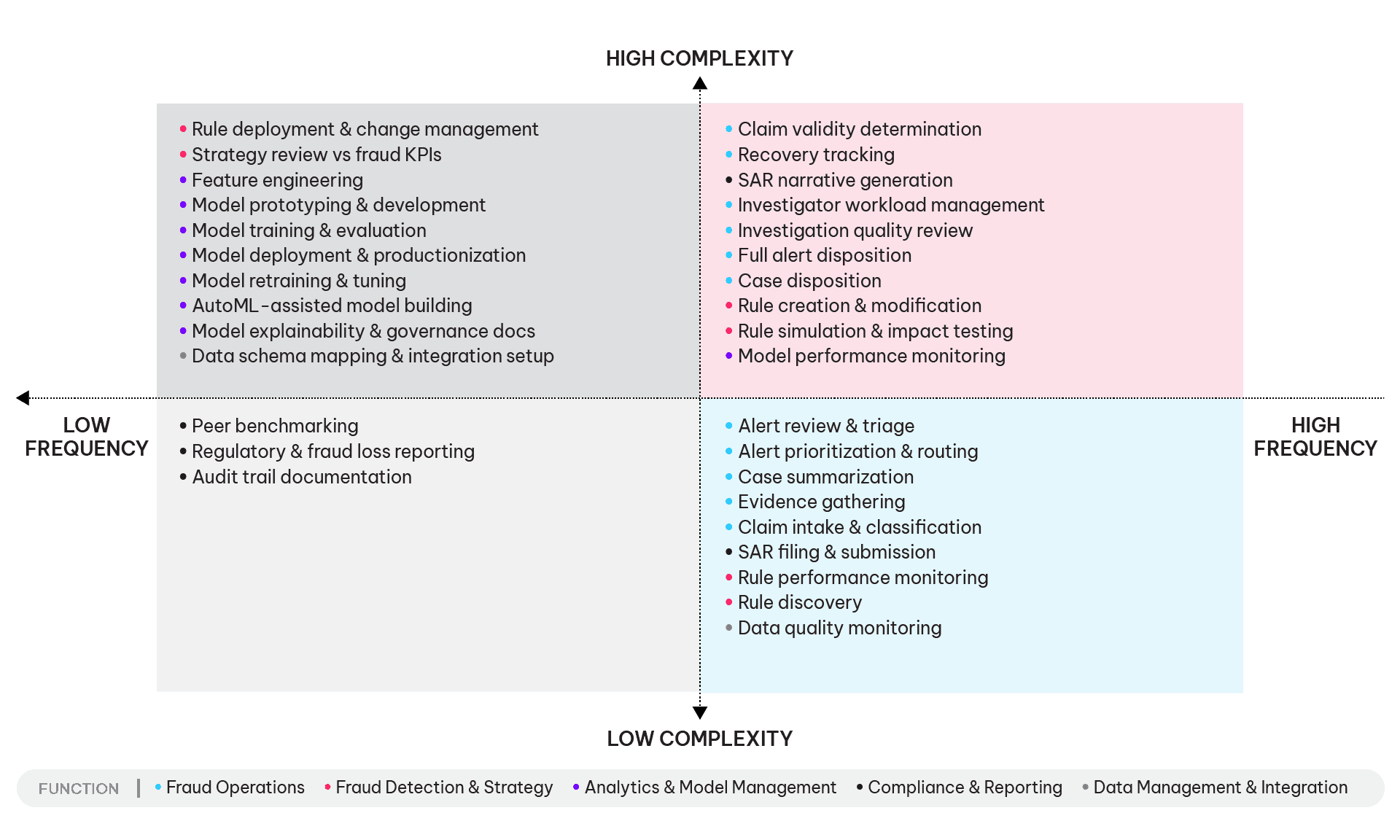
To answer that question, I reviewed functions across the fraud prevention and investigation spectrum and mapped them across two axes — frequency and complexity. To place each function in the resulting quadrant map, I assessed four factors:
The degree to which the workflow is structured or judgment-dependent
The number of stakeholders and approval layers involved
The complexity of the data and systems required
The consequence of an error.
Together, these two dimensions shape the nature of an investment decision: how quickly it can be validated, how much organizational change it demands and how much tolerance for error the use case allows. The result is a map of 32 fraud team functions plotted across four quadrants. Each quadrant tells a different story about where AI investment stands today and what it will take to go further. Not every task on this map requires full agentic capability. Some lower-complexity, high-frequency functions are well served by structured automation, and that is a legitimate starting point. But the majority of tasks across the map, particularly those involving multi-source data, contextual judgment or dynamic workflows, meet the bar for genuine agentic AI. The framework is designed to help institutions sequence both. The further a task moves toward the high-complexity end of the spectrum, the more it depends on exactly the reasoning and multi-tool orchestration that genuine agentic AI requires. Conflating the two leads to applying the wrong tool to the wrong problem.
The Agentic AI Opportunity Matrix for Fraud Prevention
Figure: Agentic AI Opportunity Matrix – Fraud Prevention
Quadrant 1: High Complexity, Low Frequency
The top-left quadrant contains technically demanding tasks performed on a per-project basis rather than on a daily basis. These include feature engineering, model development and training, among others. These functions are foundational to fraud prevention, and errors here propagate downstream, affecting detection quality, alert volumes and ultimately fraud losses.
Focus on Augmentation Before Autonomy
AI Investment in this quadrant needs to be carefully thought through, given the impact of errors. Techniques like AutoML and AI-assisted feature engineering are already delivering significant productivity gains, but this is augmentation work, not automation. The goal is to accelerate the development of expert knowledge and judgment. Institutions that treat this quadrant as a starting point will find complexity and governance requirements overwhelming. The right approach here is to start with structured subtasks, such as data validation and model documentation, before attempting anything truly autonomous.
Quadrant 2: High Complexity, High Frequency
The top-right quadrant is where the most complex and time-pressured tasks reside. This is where the case for genuine agentic AI is strongest, but the consequence of an error is highest. For example, this quadrant includes tasks such as regulatory reporting and claim validity determination. An error in either one can cause serious regulatory and reputational damage, not to mention poor customer satisfaction, leading to churn. The tasks in this quadrant involve synthesizing information from multiple sources and applying expert judgment under time constraints.
Where Agentic AI Can Deliver Strategic Value
An opportunity to apply agentic AI exists in this quadrant, but it must be deployed with precision. The highest-confidence starting points are with tasks where the inputs are structured and the output is standardized, such as SAR narrative generation or case summarization. Tasks that require decisions without human intervention are the furthest point on the implementation horizon. This is not an engineering or technical limitation. These tasks must always include a human in the loop.
Quadrant 3: Low Complexity, Low Frequency
This quadrant contains functions such as peer benchmarking, regulatory filings, fraud loss reporting and audit trail documentation. These tasks are structured, periodic and deterministic rather than judgment-dependent. This is not an area where fraud teams should anchor their AI strategy. Structured automation is the right approach for these tasks.
Quadrant 4: Low Complexity, High Frequency
The bottom-right quadrant is where most institutions should begin their agentic AI investment. The functions here are performed daily at high volume, and while they require domain knowledge, the workflows are structured to be well served by AI, with measurable, verifiable outcomes. Some of the tasks listed in this quadrant would benefit from structured automation, but others meet the genuine agentic bar, i.e., “a multi-step, multi-tool, reasoning-dependent task.”
Alert Triage as a High-Value Agentic Use Case
Alert triage and review is a good example to illustrate the benefits. Currently, fraud analysts and investigators spend time reviewing alert screens for available information. Still, they also rely heavily on external systems to gather additional supporting information, such as transaction history from core systems, additional customer details from CRM systems or 3rd-party risk signals that have not been integrated into the case management system. Much of the investigator's time is spent synthesizing the information from multiple systems. This is a task where agentic AI could deliver significant gains by reducing the time required to gather, synthesize and propose actions based on historical cases. The investigator still retains control of the decision, but the overall time spent drops significantly. Successful deployments in such use cases help generate both the framework and the feedback data for the models and, more importantly, institutional confidence in AI adoption, which is critical to anti-fraud programs. The case for starting here is not just that the tasks are tractable. It is that starting here builds the institutional foundations required to move into the top-right quadrant over time.
Conclusion: Start Where Impact Is Measurable
With the growing number of reported fraud cases, increasing alert volumes and a shortage of trained anti-fraud professionals, the pressure on executives to adopt AI will not ease. This framework is meant to serve as a blueprint for organizations as they define their AI investments. Each organization's quadrants might look a little different, and tasks will vary. Starting in the bottom-right quadrant should not be seen as settling for simple use cases, but rather as the foundational work to be done before progressing to more complex tasks.