


- Companies and trusts must hold and report their own beneficial ownership information
- Where a financial account holder is an intermediary structure, banks are required to look through that entity and report its beneficial ownership
- National regulators must establish and maintain central registers of beneficial ownership data on corporate and other legal entities and certain trusts
- Home and host regulators (and financial intelligence units) must cooperate to monitor cross-border arrangements
- Specific minimum sanctions are being introduced that European member states should ensure are available for systematic breaches of the key requirements, namely client due diligence, record keeping, and suspicious activity reporting and internal controls
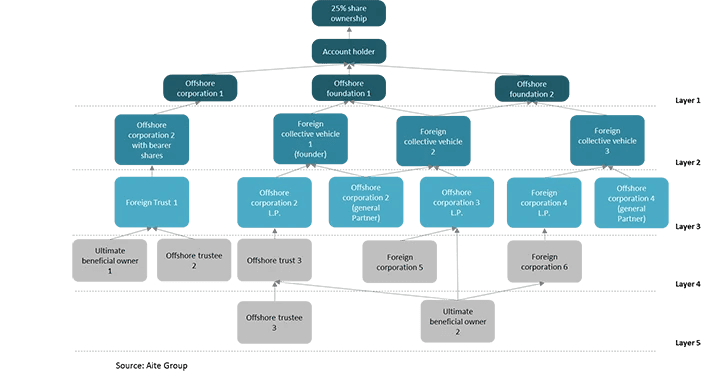
- The complexity of piecing together legal entity structures, especially in a cross-border context (as depicted in the diagram below)
- Many countries lack a public office or central source for ownership information
- The definition of beneficial ownership can vary by country—Spain, for example, has a very vague definition compared to Germany
- Ownership details do not always remain static—so active refresh is required to pick up any changes
- Gathering this data from clients can be seriously inefficient if it is not via a centralized function; hence clients may be required to submit data and documentation to different desks multiple times
- The inability to quickly and painlessly onboard a client or create a new account for an existing client can result in the loss of the opportunity to a competitor
Potential Differences Ahead
European Union member states have until December 31, 2017 to transpose AMLD IV into regulation. Though directives are binding on European member states once they have been sanctioned by the European Commission and passed by the European Parliament, there is some scope for national regulatory discretion (an opportunity for interpretation or amendment) during the transposition of the requirements into national law. Discrepancies between national interpretations could make compliance a much harder task for financial institutions in scope.Tackling each of the regulations in isolation (and other related KYC regulations) is inefficient and potentially cost-prohibitive; hence many firms are looking to strategically link related requirements to a wider program of work. Though many firms are still meeting regulatory requirements in a tactical manner, the intent of many KYC and legal entity data teams is to ensure that these projects build upon each other to create a consolidated hub for regulatory data that is linked to individual clients. Traditionally, client onboarding teams have been tasked with balancing speed of onboarding with the rigor applied to KYC checks—a hub in which processes and data is stored on one central system and shared across business units (where possible) could ensure this balance is achieved.From the regulatory perspective, centralization, standardization, and transparency of process as required under AMLD IV are significant benefits, especially when pursuing entities potentially engaged in suspicious activities, such as terrorist financing. From the industry side, increased transparency could improve awareness of potential threats to a firm’s integrity and reputation, especially if financial penalties are on the horizon. Centralized, electronic storage of documentation is also beneficial, as it is much easier to locate and check documents in this manner than to sift through hard copy data. If hard copies are required by the local regulator, metadata can be created to track the location and status of the documentation.On this note, financial penalties for non-compliance with AML and KYC legislation have been gradually increasing over the last few years. The diagram below highlights the financial penalties imposed by the United Kingdom’s Financial Conduct Authority over the last few years for AML and KYC failings.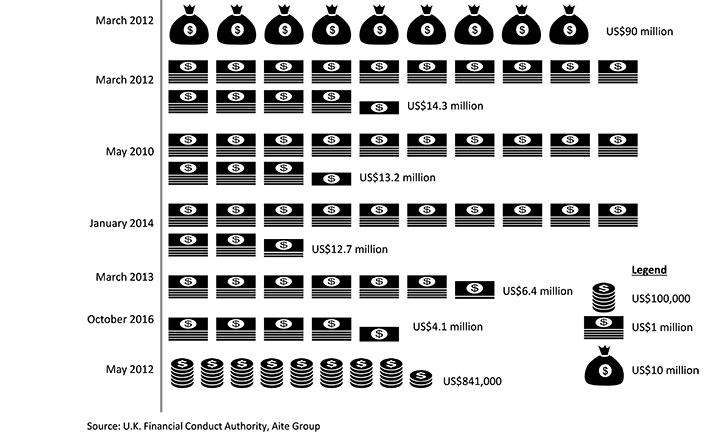
Visit the Actimize Culture of Compliance site for more resources!