
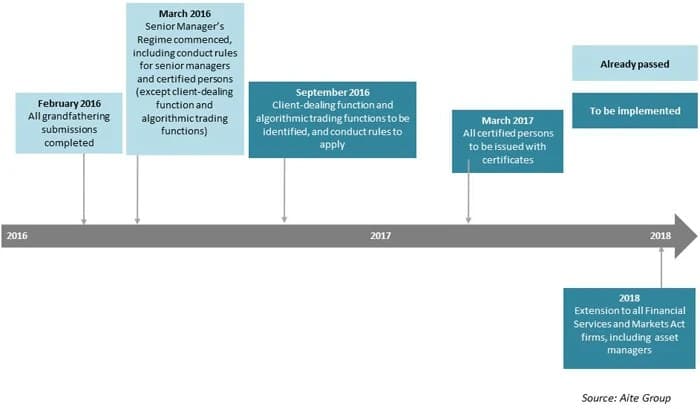
The first phase came into force on 7 March 2016 and aims at ensuring senior managers have a statutory duty of responsibility to take reasonable steps to prevent regulatory breaches in their area of responsibility. Firms were also required to identify individuals engaged in certain functions that should be certified; March 2017 will see the mandatory implementation of the certification regime for these individuals. High level conduct rules for staff will be introduced in September 2016.
- Material risk takers (these individuals can be based outside of the U.K. if they deal with U.K. accounts and work for U.K. firms)
- Individuals dealing with client money and assets
- Individuals engaged in benchmark submission and administration
- Those considered to be engaged in significant management
- Those in customer-facing roles with a required qualification
- Proprietary traders
- Line managers of certified individuals
- Client-dealing function (with respect to wholesale activities)
- Algorithmic traders
- You must act with integrity
- You must act with due skill, care and diligence
- You must be open and cooperative with the FCA, the PRA and other regulators.
- You must pay due regard to the interests of customers and treat them fairly.
- You must observe proper standards of market conduct.
Under the incoming certification regime, banks, building societies, and investment firms will be required to regularly submit robust documentation to the FCA, including an audit trail of the checks that have been completed. To this end, any individual who fits into the prescribed functions must be certified as “fit and proper”, both on their recruitment and annually thereafter, though some firms may opt to allow these individuals to self-certify. Legal, compliance, and HR teams must cooperate to ensure that any individual subject to conduct rules is aware of the rules, trained on what they mean to them, and, of course, complies. The regime therefore encompasses the introduction of governance rules, staffing, policy, and process changes, and data gathering aspects for reporting.In line with the FCA’s focus on encouraging whistleblowing, firms under the remit of the conduct rules must report any suspected breaches, thoroughly investigate these breaches (which necessitates an audit trail of these activities), and report the outcome to the regulator.Employee onboarding processes must be duly altered to incorporate the new checks to prove candidate suitability, certification processes, and training to establish key roles and responsibilities at the outset. Hiring managers must ensure that candidates understand why they are being screened, the processes involved, and documentation required, including specific data for appropriateness assessment. Annual employee screening or, at the very least, annual employee self-certification must be conducted for firms to remain in compliance with the rules.

Though the burden of proof is on the regulator, the FCA has stressed that it is keen to see “genuine accountability” rather than a box ticking approach on the part of the firms in scope; hence noncompliance is likely to be aggressively pursued. As well as incurring financial penalties and bans for individuals, firms will face punitive measures and reputational damage for infractions.